In-depth guide
How to Build Habits That Stick, and What to Do When They Don't
Learn how to build habits with a reliable cue, a useful minimum and a plan for missed days, plus worksheets and an honest look at how long it takes.
Download the free PDFNo sign-up needed. Same guide, formatted for reading offline or printing.
The short answer: To build a habit, choose one useful action and do it straight after a cue you reliably meet, such as pouring your first coffee or arriving home. Make the first version small enough for a bad day and get everything you need ready in advance. Keep a simple record so you can see what gets in the way, then change one thing at a time. When you miss, return at the next opportunity rather than starting over. Habits form at different speeds; neither 21 days nor a perfect streak is required.

Most people who want a new habit already know what it is. Read more. Walk every day. Stretch before bed. Drink water before the second coffee. The difficulty is rarely the idea. It is that the action depends on remembering and wanting to, and both are unreliable on an ordinary Tuesday.
A habit is the way round that. Psychologists define it as an action that a familiar situation prompts almost automatically, because it has been repeated in that situation many times. As a habit develops, the situation does more of the remembering and persuading, and you do less. You probably do not deliberate about brushing your teeth each night; the bathroom, the time and the toothbrush prompt it. Building a habit means arranging for a new action to be repeated in the same situation often enough that it starts to work the same way.
That gives this guide its shape. The method is a four-part loop:
- Choose. Pick one action worth repeating, and a minimum version you can do on a bad day.
- Anchor. Attach it to a cue that actually happens: something you already do, in a place you are already in.
- Repeat. Do it at each planned opportunity and keep a light record of what helps and what gets in the way.
- Return. When you miss, come back at the next opportunity, and change the design if the same thing keeps stopping you.
You can adjust the design as you learn what works; the loop is built for that. A habit that took three redesigns is still a habit.
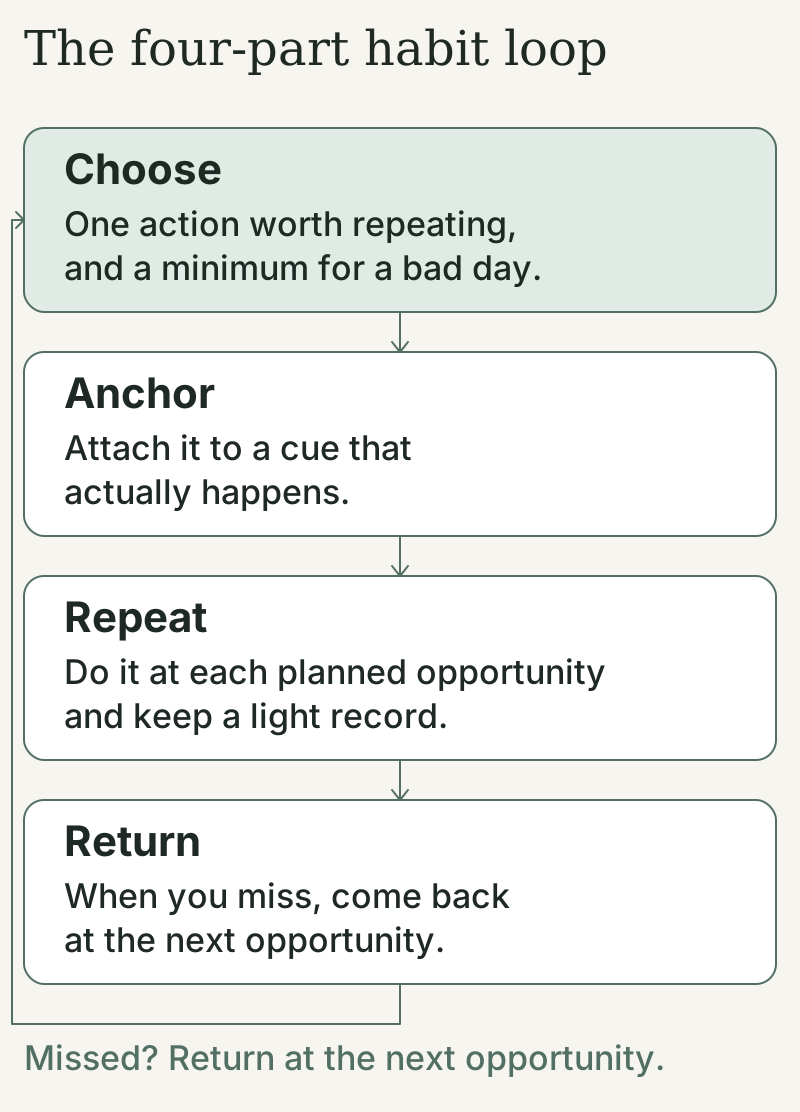
The loop, the timings and the worksheets are practical tools informed by the research cited throughout. They have not themselves been tested as a programme. Where a claim rests on a study, the study is named and listed in the sources and research notes.
Where to begin. To design a habit right now, go to starting today. If you have missed days and feel like giving up, go to returning after a miss. If a habit keeps failing however hard you try, go to the troubleshooting chapter.
How to start building a habit today
Allow about ten minutes to make a first plan, then try it at the next opportunity. Do this before reading the theory; the later chapters will make more sense with a real habit in mind.
1. Pick one action. Not an outcome ("get fit") or a trait ("be more organised"), but something you could be seen doing: "walk to the end of the road and back", "read one page", "put tomorrow's clothes on the chair".
2. Choose the moment it follows. Find something you already do every day you want the habit to happen, and put the new action straight after it. Write it as a sentence: After I [existing action], I will [new action].
3. Decide what counts on a bad day. Write a minimum version that still means something. For a reading habit, one page. For exercise, putting on your shoes and walking for five minutes. On good days you can do more; on bad days the minimum keeps the connection between the cue and the action alive.
4. Get it ready. Put the book on the pillow. Leave the shoes by the door. Fill the water bottle the night before. Anything you have to find, unlock or set up is a reason to skip.
5. Mark your first opportunity. Decide which day and moment will be the first. If the cue happens tonight, that is your first opportunity.
That is a complete habit design. Writing a specific if-then plan like this is one of the better-supported techniques in behaviour research: in a review of 94 independent tests, people who spelled out when, where and how they would act were more likely to reach their goals than people who only held the intention (Gollwitzer and Sheeran, 2006). If-then planning improves goal attainment on average; here, it gives you a specific opportunity to practise the action. The plan does not form the habit for you. Repetition does that.
The Habit Design Card
Fill this in on paper, in a note on your phone, or in the free PDF version of this guide.
- Why I want this habit (one line):
- The action (something I could be seen doing):
- The minimum that still counts:
- The fuller version, on good days (optional):
- The cue (After I ______, I will ______):
- Where it happens:
- What I need ready, and where I will put it:
- Which days it is meant to happen:
- My first opportunity:
- The date I will review how it is going (about two weeks from now):
A worked example
Ana wants to read more fiction. Her first attempt, "read for 30 minutes a day", has failed twice: by the time she has free time, she is on her phone. She fills in the card differently this time. Why: "I miss being absorbed in a story." Action: read a novel in bed. Minimum: one page. Fuller version: until she feels sleepy. Cue: after I plug my phone in to charge, I will open my book. Where: in bed, with the charger moved to the chest of drawers across the room so the phone stays out of reach. Ready: the book on her pillow each morning. Days: every night. First opportunity: tonight. Review: in two weeks.
The design does three jobs her first attempt did not. It names a moment that happens every night, it makes the first step tiny, and it moves the competing habit (the phone) out of the way.
Ana, like Marcus, Leila and Sam later in this guide, is an illustration rather than a real person, but every element of her card comes from the chapters that follow.
How habits form through cues and repetition
It helps to know what you are building, because the mechanism explains why some popular advice works and some does not.
A habit is a learned link between a situation and an action. Each time you do the action in the same situation, the link gets a little stronger, until the situation starts to prompt the action without a decision (Gardner and colleagues, 2012). The situation can be a place, a time, a preceding action or a mood. The action becomes the default response to it.
Two findings from habit research are worth knowing.
First, strong habits are triggered by the situation, not by your goals. In two experiments, places and other context cues automatically triggered strongly habitual behaviour, while people's current goals had little effect on it. Yet people still believed their habits were driven by their goals (Neal and colleagues, 2012). This helps explain why familiar surroundings, such as your bed with your phone beside it, can prompt scrolling even when you intend to stop. Changing those surroundings may help you act on that intention, and choosing a good cue for a new habit uses the same mechanism in your favour.
Second, goals start habits, and repetition takes over. A review of habit research describes the usual path: you pursue a goal by repeating an action in a particular context, and with enough repetition, control shifts from the goal to the context (Wood and Rünger, 2016). Motivation gets you through the early repetitions. It does not have to last forever, because a formed habit needs less of it.
This explains why intentions so often fade. Advice about what to change engages deliberate thinking, and its effect tends to be short-lived because attention and motivation wane (Gardner and colleagues, 2012). A review of health behaviour interventions describes the same pattern: programmes that raise knowledge and good intentions typically produce short-term change, and the more durable approaches build new habits while disrupting the cues for old ones (Wood and Neal, 2016).
There is also a practical reward for getting this right. In diary studies, people doing habitual actions tended to think about other things while doing them and reported less stress than during non-habitual actions (Wood, Quinn and Kashy, 2002). And across six studies, people with higher self-control appeared to rely less on effortful resistance and more on helpful habits, which may partly explain why they made better progress on their goals (Galla and Duckworth, 2015). Much of what looks like willpower may be good habits doing the work.
Habit, routine or task?
These words get used loosely, and the distinction affects how you build each one.
- A habit is a single action triggered by a cue: putting your keys in the bowl when you walk in.
- A routine is a sequence of actions, such as a morning routine. Individual steps can become habitual, while other parts of the routine still need deliberate attention.
- A task is something you do once, or occasionally, by deliberate choice: renewing a passport.
If something happens irregularly and needs judgement each time, it is better managed as a task with a reminder than forced into a habit. The task-or-habit guide walks through the decision.
What this means in practice
Three implications run through the rest of this guide:
- Choose the situation as carefully as the action. The cue is what will eventually do the remembering for you.
- Keep the situation stable. The same cue, the same place, as often as you can manage. Repetition in a consistent context builds the link; repetition in a different context each time builds it more slowly.
- Automatic usually means automatic to start. A habit can make you lace your running shoes without deliberating; the run itself may still take effort. That is normal, and it is still a habit.
Choose: pick a habit and a useful minimum
Choose an action you value and a version you can manage when the week gets busy. Both matter.
Start with why, then make it visible. Write one line about what you hope the habit will give you, then translate it into an action you could be seen doing. "Be calmer in the evenings" becomes "write tomorrow's three tasks on a card before closing the laptop". "Get stronger" becomes "ten squats while the kettle boils". The action should tell you clearly when you have done it.
Pick a version you will actually do on a bad day. The minimum is not a fallback for failure; it is what keeps the link between cue and action alive when time or energy runs out. In the best-known study of habit formation in everyday life, simple actions such as drinking a glass of water became automatic faster than more demanding ones such as doing 50 sit-ups (Gardner and colleagues, 2012, describing Lally and colleagues, 2010). In a study of 111 new gym members, simpler workouts were one of the things associated with stronger exercise habits (Kaushal and Rhodes, 2015). A smaller action is easier to repeat when time is short, and repetition is what forms the habit.
A useful minimum has three properties:
- It is short enough for a difficult day; a minute or two is a useful starting point, not a requirement.
- It is the real action in miniature, not a substitute. One page of the book, not "thinking about reading".
- It is easy to start where the cue happens, with no extra setup.
Choose the enjoyable version, not just the useful one. In experiments, people who chose the exercise they enjoyed most, rather than the one they thought most useful, persisted longer, and adding an immediate reward (such as music in a classroom) increased persistence in the activity (Woolley and Fishbach, 2016). In follow-up studies, how enjoyable an activity felt at the time predicted whether people kept going with New Year's resolutions, studying and exercise better than the long-term benefits did (Woolley and Fishbach, 2017). If you dislike running, a habit of walking with a podcast you love may serve you better than a running habit you dread.
Choose it yourself. A recent review of habit formation studies found that self-selected habits generally showed greater habit strength than assigned ones (Singh and colleagues, 2024). Choose an action you value yourself, even if someone else first suggested it. In a survey of young adults, physical activity people did because they enjoyed or valued it was associated with stronger habits (Gardner and Lally, 2013); that study could not show which came first, but it fits the same picture.
Start with one. Each new habit needs its own cue, preparation and attention in the early weeks. Begin with one experiment and add another once the first runs with little thought. The guide on how many habits to track at once covers managing a set of habits once you have several.
The bad Tuesday test
Before you commit, picture your hardest ordinary day: a late meeting, a child awake at night, a long commute. Ask: on that day, could I still do the minimum, at that cue, in that place? If the answer is no, shrink the minimum or move the cue until it is yes. A plan that works on good days also needs to work on an ordinary difficult one.
| What you want | Too vague | A visible action | A meaningful minimum |
|---|---|---|---|
| Read more | "Read more books" | Read a novel in bed | One page |
| Move more | "Exercise regularly" | Walk around the block after lunch | Walk to the corner and back |
| Feel less rushed in the morning | "Be organised" | Put tomorrow's bag by the door after dinner | Put the keys and pass in the bag |
| Drink more water | "Stay hydrated" | Drink a glass of water before the first coffee | Three sips |
| Keep in touch | "Be a better friend" | Message one person while the pasta boils | One line |
If you are short of ideas for low-energy days, small habits for busy days has a longer list of minimum versions by category.
Anchor: choose a cue that actually happens

The cue is the most important design decision, and the one people often spend least time on. "Every morning" and "when I have time" leave the starting moment unclear. Choose a recognisable event or a specific time.
Write an if-then sentence. The format is simple: After I [existing action], I will [new action]. Or, for a place: When I [arrive somewhere], I will [new action]. The if-then structure is the implementation intention from the review mentioned earlier, which found a medium-to-large average effect on reaching goals (Gollwitzer and Sheeran, 2006). Attaching a new action to an existing one is often called "habit stacking", a name popularised by books such as James Clear's Atomic Habits. Related evidence comes from research on if-then plans and on linking a new action to an existing routine; it does not validate every version of habit stacking.
Put the new action straight after the existing one. In one small study, 50 people trying to build a flossing habit were told to floss either before or after brushing their teeth. Those who flossed after brushing tended to form stronger habits, and eight months later they still had stronger flossing habits and flossed more often (Judah and colleagues, 2013). It was a small, exploratory study, so treat it as a useful pointer rather than a law. The likely reason is practical: the end of an existing action is a clear moment, while "before" requires you to remember the new thing first.
A good cue has five qualities:
- It happens on every day you want the habit. If you want to stretch daily but your cue is "after my gym session", you have built a three-day-a-week habit.
- It is specific. "After I pour my first coffee" is a moment. "In the morning" is three hours.
- It happens where the action can happen. A cue at the front door is no use for a habit that needs your desk.
- It ends cleanly. "After I switch off the laptop" has a clear end. "After work" may blur into answering one more message.
- It is not already crowded. If your cue is the moment you are wrangling children into coats, a new habit will lose.
Event cues and time cues both work. An event cue rides along with something you already do. A time cue such as 7pm may be easier to notice with an alarm or reminder, at least at first, because clock times are easy to drift past. Neither is always better. Event cues tend to suit routines that vary in timing; time cues suit actions with no natural anchor. If you use a reminder, place it at the moment the action can happen, not hours before; the guide on when to set a task reminder applies to habits too.
Prepare the place. The cue only works if the action can start immediately. Put what you need where the cue happens, remove a step from the start, and move competing temptations out of reach. In the gym study, the environment was one of the factors that predicted stronger exercise habits, alongside consistency and simple routines (Kaushal and Rhodes, 2015).
When your schedule is irregular
Shift work, caring responsibilities, travel and changing timetables make a fixed time impossible. Some ways to anchor anyway:
- Anchor to something that travels with you. Your first drink of the day, arriving at a workplace, taking off your shoes at home, or plugging in your phone. These happen whatever time the day starts.
- Use two cues for two kinds of day. "On office days, after I sit at my desk; on home days, after I clear breakfast." Two clear cues are better than one vague one.
- Plan which days count. If the habit is only realistic on four days a week, plan for four. A target that fits your week is easier to keep than a daily target you miss three times. Planned rest is neutral, not a gap; rest days and habits explains why.
Worked example: a nurse on rotating shifts
Marcus, a nurse who works rotating day and night shifts, wanted a stretching habit for his back. "Every evening" failed because his evenings moved. He anchored it to taking off his work shoes after a shift, whenever that was, with a two-minute minimum on the hallway rug where the shoes come off. On days off, his cue became putting the kettle on for his first tea. Same action, two reliable moments.
When the cue keeps failing
If you keep forgetting, it is tempting to blame your memory. First check the cue. Did it happen? Did you notice it? Was the action possible at that moment? Check whether the cue was absent, easy to miss or already occupied by something else before changing the plan. Moving the action to a better cue is often more effective than trying harder to remember.
Repeat: track opportunities and learn what helps
Repetition is the mechanism. In the everyday-life study, people repeated a chosen eating, drinking or activity behaviour after the same daily cue for 12 weeks, and their sense of doing it automatically rose with repetition: quickly at first, then more slowly towards a plateau. People who performed the behaviour more consistently fitted that pattern better (Lally and colleagues, 2010).
So the job in this phase is simple: do the action at each planned opportunity, at the minimum if necessary, and pay attention to what gets in the way.
Count opportunities, not calendar days. If your habit is planned for weekdays, a skipped Saturday is not a miss. Record against the opportunities you planned, so your record reflects your design rather than an abstract daily standard.
Keep a light record. Tracking is one of the better-supported tools for any goal. A review of 138 experiments found that interventions that got people to monitor their progress more often improved their goal attainment, with larger effects when progress was physically recorded or reported to others (Harkin and colleagues, 2016). Those studies measured reaching goals, not habit strength, and a full tracker does not prove a habit has formed. But a record shows you patterns you would otherwise miss, such as a habit that never happens on Thursdays.
Record four things, not more:
- Did the cue happen?
- Did you do the action, and was it the minimum or the fuller version?
- If not, what got in the way?
- Anything worth changing?
The Opportunity Log
Use one line per planned opportunity. Leave unplanned days blank rather than marking them as failures.
| Date | Cue happened? | Did it? (minimum / fuller / no) | What got in the way | Note |
|---|---|---|---|---|
At the end of each week, add one line: Next week I will keep the design / change this one condition: ______. If it is working, keep it. If not, one change at a time lets you see what made the difference.
Reading your record
After two weeks you will usually see one of three patterns:
- It mostly happens. Keep going. Resist the urge to add more until it feels easy to start.
- It happens on some kinds of day but not others. Look at the difference. Usually the cue is missing on those days, or something competes with it. Add a second cue for that kind of day or change the target days.
- It rarely happens. The design is wrong somewhere, not you. Use the troubleshooting chapter to find which part.
Non-daily habits work too. Not every habit should be daily. In the study of 111 new gym members, exercising at least four times a week for about six weeks was the minimum associated with establishing an exercise habit (Kaushal and Rhodes, 2015). That figure comes from one group of new gym-goers and is not a prescription, but it shows that habits can form around regular, non-daily repetition when the cue and context stay consistent.
If you keep your record in Dayprints, each habit can have its own target days and a number of times per day, so a three-times-a-day water habit shows progress like 2/3 rather than a fail. A partial count contributes to your Rhythm, reaching the daily target can also add Momentum (within the app's daily limit), and a partial count is never reported back to you as a shortfall. The broader tracking method, on paper or in any app, is in the calm habit tracking guide, and if you have never tracked anything before, habit tracking for beginners sets up a first week.
How long does it take to build a habit?
The honest answer is that it varies a great deal, and the popular number is wrong.
The 21-day figure has no good evidence behind it. It seems to have come from anecdotal observations of how long patients took to adjust to their appearance after plastic surgery, which says nothing about forming a new action (Gardner and colleagues, 2012). It persists because it is short and encouraging, which is exactly why it causes trouble: people who still find a habit effortful on day 22 conclude they have failed.
The best-known study estimated a median of about two months, with a very wide range. In the everyday-life study, 96 volunteers each chose one behaviour to repeat daily after the same cue for 12 weeks. Among the 39 participants whose data fitted the researchers' model well, the estimated time to reach 95% of their own automaticity plateau ranged from 18 to 254 days, with a median of 66 days (Lally and colleagues, 2010). The longer estimates are projections beyond the 12 weeks of the study, which is worth knowing when you read headlines about "up to 254 days".
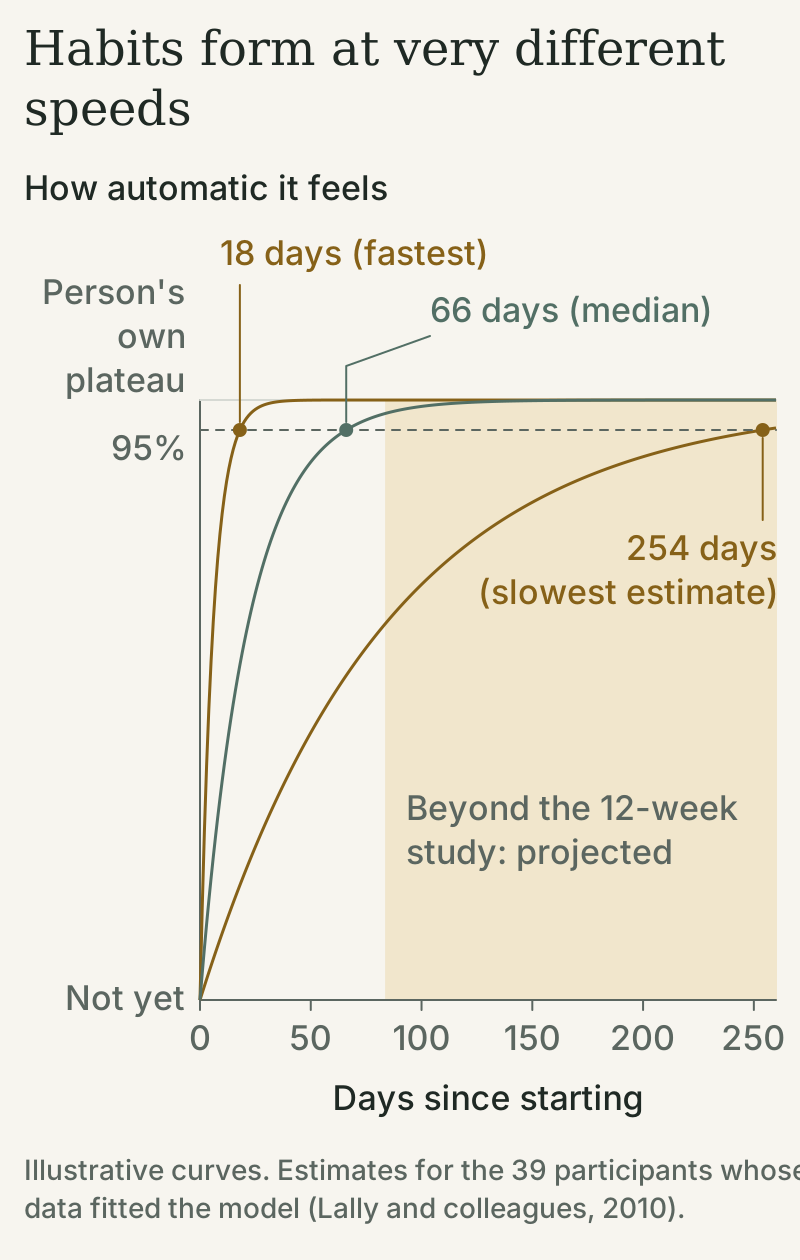
A 2024 review found a similar picture. Across 20 studies with 2,601 participants, four reported how long habits took to form. The medians were 59 to 66 days, and individual times ranged from 4 to 335 days (Singh and colleagues, 2024). The authors noted that the evidence base is small and that many studies had a high risk of bias, and most concerned health behaviours such as flossing and diet.
Several things seem to affect the speed:
- Complexity. In the everyday-life study, simpler actions tended to become automatic sooner than demanding ones, though the evidence is limited.
- Consistency. In the everyday-life study, more consistent repetition was associated with automaticity ratings that fitted the researchers' model more closely.
- Choice and timing. In the 2024 review, self-selected habits and morning practices generally showed greater habit strength, though the evidence is limited.
Why ten weeks is a review point, not a finish line
Drawing on the everyday-life study, members of the same research group suggested telling patients to expect a new daily habit to take around ten weeks (Gardner and colleagues, 2012). That makes ten weeks a sensible point to review, not a deadline. By then you will know whether the habit is getting easier, which design changes helped, and whether you still want it.
You may notice signs of a forming habit before then:
- You start the action before you have consciously decided to.
- Skipping it feels odd, as if something is missing from the moment.
- Starting needs less deliberate prompting, even on days you do only the minimum.
- You notice the cue less, because the action tends to follow it.
Some habits never feel fully effortless, especially long or demanding ones. A morning run can be a firm habit and still be hard work. If the decision to start has disappeared, the habit has done its job.
Return: what to do after missing a habit
Everyone misses. The difference between habits that last and habits that fade is often what happens next.
One miss does not break the process. In the everyday-life study, missing a single opportunity did not materially affect habit formation (Lally and colleagues, 2010). A commentary by members of the same research group put it plainly: automaticity gains soon resumed after a missed performance (Gardner and colleagues, 2012). One missed opportunity is not evidence that the habit has failed. Check what happened and make the next attempt feasible.
Be careful with streaks. A streak can be motivating while it lasts. Across seven studies, people shown an intact streak of a behaviour were more likely to do it again than people shown a broken streak, even when their actual past behaviour was the same. The drop after a break was larger when people blamed themselves for it, and smaller when they could repair the streak (Silverman and Barasch, 2023). That is the risk: if your record treats a miss as a broken chain, the record itself may make returning harder. If a broken streak discourages you, try a record that makes completed opportunities and returns visible. Streaks versus momentum compares the two ways of measuring.
Do not make up the missed days. Doing double tomorrow turns a habit into a debt. The habit is the link between the cue and the action; you strengthen it at the next real opportunity, not by repaying the past. The detailed restart sequence is in how to restart a habit after missing days.
Be kind to yourself, for practical reasons. In four experiments, people encouraged to treat a personal failure with self-compassion were more motivated to improve than people in comparison conditions, and in one of them spent longer studying for a difficult test after failing a first attempt (Breines and Chen, 2012). Describe the miss without judging yourself, then choose one practical change.
The return rule
When you miss, apply one rule: do the minimum at the next opportunity. Not the fuller version, not a catch-up session. The minimum, at the next cue.
If you miss twice in a row for the same reason, treat it as information rather than a lapse. Something in the design is not working: the cue is absent, the action is too big, something easier competes with it, or your circumstances have changed. Change one thing and try again.
Longer breaks
Illness, travel, a new baby or a hard month can stop a habit for weeks. That is not the same as a miss. When you can see a disruption coming, decide in advance:
- Will you pause the habit or keep a smaller version going?
- What is your return date, or the cue that will tell you it is time?
- What will the first return look like? (Usually the minimum, at the original cue.)
A planned pause is a decision, not a failure. Habit consistency without streaks covers measuring consistency across weeks that include rest.
In Dayprints, taking a break from a habit costs you nothing you have already earned: it does not reduce your Momentum or move your tier backwards. Rhythm simply restarts with your next completed task or habit check-in. That is how the app is built, not evidence that it builds habits faster; the point is that your record should never punish a return.
The Repair and Return Card
Use this when a habit has stalled, after a single miss or a long break.
- What happened (facts, not judgement):
- One-off or pattern? (Has the same thing stopped me before?)
- Which part failed? (Cue, action too big, not worth it, something easier competed, circumstances changed)
- The one condition I will change:
- My next opportunity (day and cue):
- What the first return will be (usually the minimum):
- When I will check whether the change helped:
Why your habit is not sticking, and what to change
When a habit keeps failing, the usual response is to try harder. A better response is to find which part of the design is failing and change that part. Most failures fall into one of seven patterns.
| What you notice | The likely cause | What to change |
|---|---|---|
| "I keep forgetting." | The cue is absent, unnoticed, or attached to a crowded moment. | Move the action to straight after a reliable existing action. Make the materials visible at the cue. |
| "I remember, but I don't feel like it." | The action is too big or unpleasant for the moment. | Shrink to the minimum, choose a version you enjoy, or pair it with something you like. |
| "It works some weeks and not others." | Your days vary and the cue is missing on some of them. | Add a second cue for the other kind of day, or change the target days. |
| "Something else always wins." | A competing habit is easier at that moment. | Make the new action easier to start and the competing one harder: distance, an extra step, a closed app. |
| "It stopped after I moved, changed jobs or had a baby." | The context that carried the cue has gone. | Treat it as a new habit with a new cue. A life change is a good time to build one. |
| "I do it, but it never feels automatic." | The behaviour is long or complex, or the context keeps changing. | Aim to make the start automatic. Keep the context stable. Accept that the activity itself may stay effortful. |
| "I don't care about it any more." | The habit has stopped serving its purpose. | Retire it honestly, or reconnect it to a purpose you still hold. |
Change one thing at a time and give each change a week or two before judging it. If you change the cue, the size and the time at once, you will not know which mattered.
On willpower. You may have read that willpower is a fuel that runs out over the day. In a preregistered replication across 23 laboratories and 2,141 participants, one standard ego-depletion experiment produced an estimated effect close to zero (Hagger and colleagues, 2016). That result does not justify treating willpower as a tank that predictably empties, so this guide does not rely on the idea. The practical point stands without it: good habit design reduces how often you need to rely on effort at all.
Changing an unwanted habit
The same mechanism explains ordinary unwanted habits, such as checking your phone in bed, snacking at your desk, or opening email first thing. Once habitual, these actions can be prompted by familiar contexts despite a different intention (Neal and colleagues, 2012). Changing the context is one practical approach to try.
Durable change usually works on both sides: weakening the old link while building a new one (Wood and Neal, 2016).
- Change the cue or the context. Charge the phone outside the bedroom. Keep snacks out of sight of your desk.
- Add friction to the old behaviour. Log out of the app, delete it from the home screen, or require one extra step.
- Put a new action in the same slot. The cue will still happen; give it a new response. In bed: open a book. At the desk mid-afternoon: refill the water bottle.
- Use a change of circumstances. In a field experiment with 800 participants, an intervention promoting sustainable behaviours was more effective for people who had recently moved home, consistent with the idea that a move temporarily loosens old habits; the window seemed to last about three months after the move (Verplanken and Roy, 2016). A new job, a new home or a new term is a natural window to set up the habits you want.
- Use fresh starts. In three archival studies, diet searches, gym visits and goal commitments increased after temporal landmarks such as the start of a week, month or year, a birthday or a holiday (Dai and colleagues, 2014). A Monday can be a useful moment to redesign. You do not have to wait for one.
Leila scrolled her phone in bed most nights and lost an hour of sleep. She moved her charger to the kitchen, put a paperback on her bedside table, and wrote one cue: when I get into bed, I will read until I am sleepy. On nights she brought the phone to bed anyway, she did not count it as failure; she noted what had happened and moved the charger back.
This chapter is about everyday habits. If a behaviour feels compulsive, involves alcohol, drugs, gambling or disordered eating, or is harming your health, relationships or work, talk to a doctor or a qualified professional. Habit design can support that help but is not a substitute for it.
A ten-week practice plan for one habit
You can use the loop without a programme. If you would like structure, this plan takes one habit through ten weeks. It is an editorial suggestion, not a tested protocol; ten weeks is used because it is a reasonable horizon for a simple daily habit, not because the habit will be finished by then. The weeks are review prompts: if you notice an obvious obstacle earlier, fix it then rather than waiting for its week.
| Week | Focus | What to do |
|---|---|---|
| 1 | Design | Fill in the Habit Design Card. Start at the first opportunity. Do only the minimum if you like. |
| 2 | Check the cue | Use the Opportunity Log. For each miss, note whether the cue happened. |
| 3 | Fix the cue | If the cue failed more than once, move the action to a better anchor. |
| 4 | Check the size | Are you skipping on busy days? Shrink the minimum until bad days are covered. |
| 5 | Remove friction | Find one setup step and remove it. Prepare the place the night before. |
| 6 | Practise returning | If you have missed, apply the return rule. If not, decide your plan for the next miss now. |
| 7 | Watch for competition | Is something else winning at that moment? Add friction to it or move the cue. |
| 8 | Notice automaticity | Do you ever start before deciding? Note the days it felt easy. |
| 9 | Adjust the version | If the minimum feels trivial, let good days stretch to the fuller version. Keep the minimum as the floor. |
| 10 | Review | Keep, adjust or retire. If it runs with little thought, consider starting a second habit. |
A daily example. Ana's reading habit: week 2 shows she misses on nights she falls asleep on the sofa. Week 3, she adds a second cue for those evenings: when I sit down on the sofa, I will read one page before turning on the television. Week 5, she keeps the book beside the sofa during the day and carries it to bed when she reads there.
A non-daily example. Sam wants to run three times a week. His cue is after I drop the children at school on Monday, Wednesday and Friday, I will run from the school gate, with his trainers worn on the school run. Week 4 shows Fridays fail because of a standing meeting, so he moves Friday's run to Saturday morning after the first coffee. Three planned opportunities a week, each with a cue that happens.
Missed a week of the plan? Carry on from where you are. There is nothing to restart.
If you would like a shorter, printable start, the free One Habit, One Week workbook takes one small habit through seven days with space to record each one.
Try Dayprints: Add one habit to Today with its own target days, tap it when it happens, and see partly done days still count towards your Rhythm. Your plan for the day stays separate: habits never stop a finished day from being kept as a Dayprint, a framed, dated painting in your collection. Dayprints works in your browser, and you can start on Free without a payment card.
Frequently asked questions about building habits
How long does it take to form a habit?
It varies widely. In one well-known 12-week study, estimates for the 39 participants whose data fitted the model well ranged from 18 to 254 days to reach 95% of their own automaticity plateau, with a median of 66 days; estimates beyond 12 weeks were projections. A 2024 review found medians of 59 to 66 days across the few studies that measured it, with individual times from 4 to 335 days. Simpler actions may form sooner, though the evidence is limited. See how long it takes to build a habit.
Does it really take 21 days to build a habit?
No. The 21-day figure seems to have come from anecdotes about patients adjusting to plastic surgery, not from research on forming new actions. The studies discussed here report widely varying times, often well beyond 21 days, so do not treat it as a deadline.
What is habit stacking?
Habit stacking is a popular name for attaching a new action to one you already do: "after I pour my coffee, I will write my three tasks for the day". The research behind it is on if-then planning, which reliably helps people act on their intentions, and one small study found that flossing after brushing, rather than before, was linked to a stronger habit. See choosing a cue.
What happens if I miss a day?
Very little, if you return. In the everyday-life study, missing a single opportunity did not materially affect habit formation. Do the minimum at your next opportunity, and if you miss twice for the same reason, change that part of the design. See returning after a miss.
How many habits should I build at once?
Start with one. Each new habit needs its own cue, preparation and attention in the early weeks. Once the first runs with little thought, add another. There is no proven ideal number; the right number is however many you can design properly.
Do I need to do a habit every day?
No. Daily repetition is simplest, because the cue happens every day, but habits can form around regular non-daily patterns, such as exercising on the same days each week. What matters most is that the same cue leads to the same action whenever the habit is planned.
Does tracking help you build habits?
It helps you see what is working. Experiments show that monitoring progress improves goal attainment, especially when progress is physically recorded. A tracker cannot tell you whether a habit has become automatic, though, so use it for spotting patterns, not as a verdict. See tracking opportunities.
Sources and research notes
The studies below are cited in the text. They include reviews and meta-analyses, which summarise earlier research; observational studies, which show associations rather than causes; and experiments, which test an intervention. Many habit studies are small, rely on people's own ratings of how automatic an action feels, and focus on health behaviours. The four-part loop, the worksheets and the ten-week plan in this guide are practical tools based on this research. They have not themselves been tested as a programme.
- Breines, J. G., and Chen, S. (2012). Self-compassion increases self-improvement motivation. Personality and Social Psychology Bulletin, 38(9), 1133–1143. doi:10.1177/0146167212445599
- Clear, J. (2018). Atomic Habits. Avery.
- Dai, H., Milkman, K. L., and Riis, J. (2014). The fresh start effect: Temporal landmarks motivate aspirational behavior. Management Science, 60(10), 2563–2582. doi:10.1287/mnsc.2014.1901
- Galla, B. M., and Duckworth, A. L. (2015). More than resisting temptation: Beneficial habits mediate the relationship between self-control and positive life outcomes. Journal of Personality and Social Psychology, 109(3), 508–525. doi:10.1037/pspp0000026
- Gardner, B., and Lally, P. (2013). Does intrinsic motivation strengthen physical activity habit? Modeling relationships between self-determination, past behaviour, and habit strength. Journal of Behavioral Medicine, 36(5), 488–497. doi:10.1007/s10865-012-9442-0
- Gardner, B., Lally, P., and Wardle, J. (2012). Making health habitual: The psychology of 'habit-formation' and general practice. British Journal of General Practice, 62(605), 664–666. doi:10.3399/bjgp12X659466
- Gollwitzer, P. M., and Sheeran, P. (2006). Implementation intentions and goal achievement: A meta-analysis of effects and processes. Advances in Experimental Social Psychology, 38, 69–119. doi:10.1016/S0065-2601(06)38002-1
- Hagger, M. S., Chatzisarantis, N. L. D., Alberts, H., Anggono, C. O., Batailler, C., Birt, A. R., and colleagues (2016). A multilab preregistered replication of the ego-depletion effect. Perspectives on Psychological Science, 11(4), 546–573. doi:10.1177/1745691616652873
- Harkin, B., Webb, T. L., Chang, B. P. I., Prestwich, A., Conner, M., Kellar, I., Benn, Y., and Sheeran, P. (2016). Does monitoring goal progress promote goal attainment? A meta-analysis of the experimental evidence. Psychological Bulletin, 142(2), 198–229. doi:10.1037/bul0000025
- Judah, G., Gardner, B., and Aunger, R. (2013). Forming a flossing habit: An exploratory study of the psychological determinants of habit formation. British Journal of Health Psychology, 18(2), 338–353. doi:10.1111/j.2044-8287.2012.02086.x
- Kaushal, N., and Rhodes, R. E. (2015). Exercise habit formation in new gym members: A longitudinal study. Journal of Behavioral Medicine, 38(4), 652–663. doi:10.1007/s10865-015-9640-7
- Lally, P., van Jaarsveld, C. H. M., Potts, H. W. W., and Wardle, J. (2010). How are habits formed: Modelling habit formation in the real world. European Journal of Social Psychology, 40(6), 998–1009. doi:10.1002/ejsp.674
- Neal, D. T., Wood, W., Labrecque, J. S., and Lally, P. (2012). How do habits guide behavior? Perceived and actual triggers of habits in daily life. Journal of Experimental Social Psychology, 48(2), 492–498. doi:10.1016/j.jesp.2011.10.011
- Silverman, J., and Barasch, A. (2023). On or off track: How (broken) streaks affect consumer decisions. Journal of Consumer Research, 49(6), 1095–1117. doi:10.1093/jcr/ucac029
- Singh, B., Murphy, A., Maher, C., and Smith, A. E. (2024). Time to form a habit: A systematic review and meta-analysis of health behaviour habit formation and its determinants. Healthcare, 12(23), 2488. doi:10.3390/healthcare12232488
- Verplanken, B., and Roy, D. (2016). Empowering interventions to promote sustainable lifestyles: Testing the habit discontinuity hypothesis in a field experiment. Journal of Environmental Psychology, 45, 127–134. doi:10.1016/j.jenvp.2015.11.008
- Wood, W., and Neal, D. T. (2016). Healthy through habit: Interventions for initiating and maintaining health behavior change. Behavioral Science and Policy, 2(1), 71–83. doi:10.1353/bsp.2016.0008
- Wood, W., Quinn, J. M., and Kashy, D. A. (2002). Habits in everyday life: Thought, emotion, and action. Journal of Personality and Social Psychology, 83(6), 1281–1297. doi:10.1037/0022-3514.83.6.1281
- Wood, W., and Rünger, D. (2016). Psychology of habit. Annual Review of Psychology, 67, 289–314. doi:10.1146/annurev-psych-122414-033417
- Woolley, K., and Fishbach, A. (2016). For the fun of it: Harnessing immediate rewards to increase persistence in long-term goals. Journal of Consumer Research, 42(6), 952–966. doi:10.1093/jcr/ucv098
- Woolley, K., and Fishbach, A. (2017). Immediate rewards predict adherence to long-term goals. Personality and Social Psychology Bulletin, 43(2), 151–162. doi:10.1177/0146167216676480