In-depth guide
How to Stop Procrastinating: Start, Restart and Close the Day
Learn how to stop procrastinating with a five-minute start, a plan for setbacks, and a simple way to deal with unfinished tasks at day's end.
Download the free PDFNo sign-up needed. Same guide, formatted for reading offline or printing.
The short answer: To stop procrastinating, choose one task that matters now, identify what is stopping you, and make the first action small and specific. Remove one likely distraction and give it five minutes: a moment to prepare, three minutes of work, and a moment to decide what comes next. Then continue, leave a next-step note, or deal with a blocker. If you lose time, restart with one remaining priority. At the end of the day, decide what happens to unfinished work.

Procrastination rarely looks like doing nothing. It looks like clearing the inbox before the report, researching one more tool, or opening the document and closing it again. The task stays on the list, and it gets a little heavier every time you walk past it.
Beginning is only part of the problem. Real days also include false starts, lost afternoons and work that is still unfinished at 6pm. This guide covers all three: how to start, how to get back on track when you drift, and how to close the day so that unfinished work does not follow you into the evening.
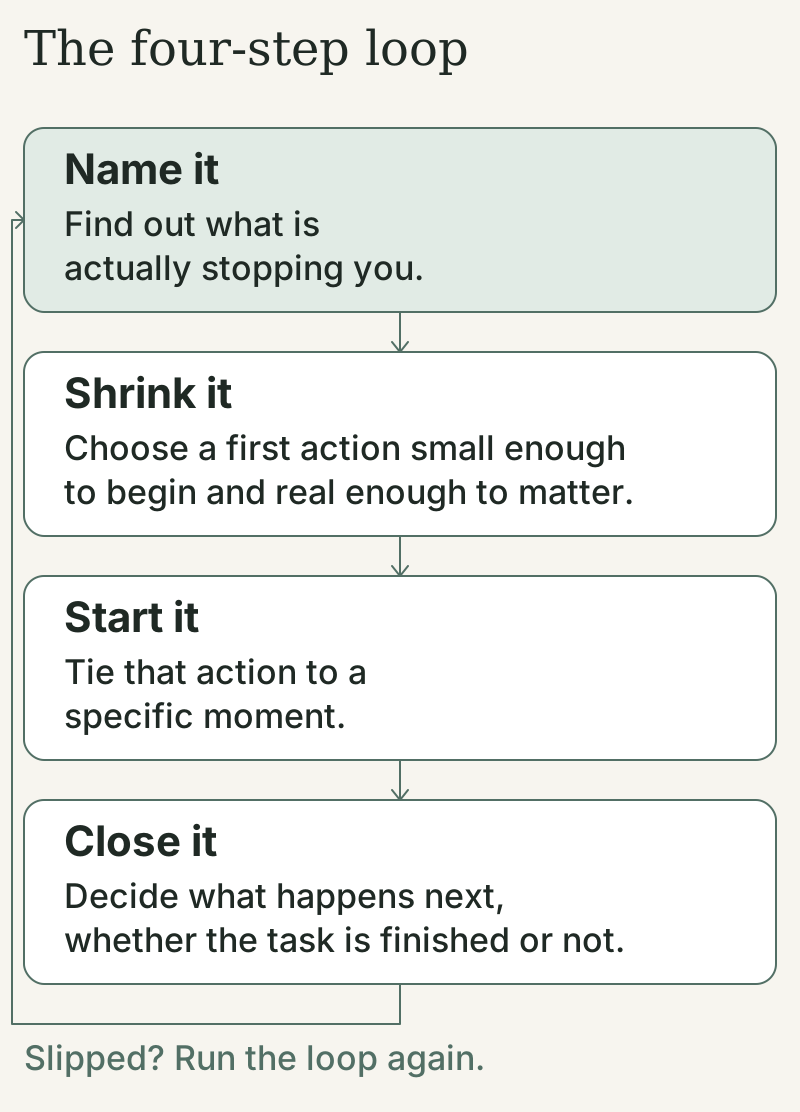
The method is a four-step loop you can run on any task, on paper or in any app:
- Name it. Find out what is actually stopping you.
- Shrink it. Choose a first action small enough to begin and real enough to matter.
- Start it. Tie that action to a specific moment.
- Close it. Decide what happens next, whether the task is finished or not.
When you slip, you do not need a new system. You run the loop again.
The loop, the timings and the worksheets are practical tools built on the research cited throughout; they are not a tested treatment. Where a claim rests on a study, the study is named and listed in the sources and research notes.
Where to begin. If you are stuck right now, go straight to your first five minutes. If you have already lost time today, jump to restarting. If the day is nearly over, go to deciding what happens to unfinished tasks.
How to stop procrastinating right now: your first five minutes
If there is a task you are avoiding at this moment, do this before reading anything else. It takes five minutes. The timings are suggestions rather than a research-tested dose; their job is to end the deliberation and move the task.
0:00 to 0:30. Choose one task. Pick the one that matters most now, not the one that is easiest to feel good about. If two tasks compete, choose the one with the nearer real consequence and put the other out of sight.
0:30 to 1:00. Name the obstacle and the first action. Finish two sentences: "I don't want to start because…" and "The first thing I would physically do is…". Keep the first action to a verb and an object: open the budget spreadsheet, write the subject line, find the letter from the council.
1:00 to 1:30. Prepare only what that action needs. Open the one file. Put the phone face down or in another room. Close the tab you know you will drift to. Stop preparing as soon as the first action is possible.
1:30 to 4:30. Do the action. Work on that one thing for three minutes. Aim to change the state of the task: a sentence written, a figure checked, a question listed. If you can, go one step beyond opening the app: add a note, check a figure or identify the question you need answered.
4:30 to 5:00. Choose what happens next. You have three good options:
- Continue if the work is moving. Many tasks feel different once the uncertain opening has passed.
- Pause with a next step if you need to stop. Write the next action where you will see it: "Next: add the March figures from the bank statement."
- Name the blocker if you hit one. If information, access or a decision is missing, identify anything you can do to unblock the task. If you have already asked and must wait, note when to follow up and choose something else.
You may still feel reluctant when the five minutes end. You do not have to feel motivated for the attempt to have been useful. Notice what you learned: the next step may be clearer, or you may now know what information or support is missing.
A worked example
The people in this guide's examples are illustrations, not real clients or readers.
Priya, a project manager, has spent two days avoiding a reply to a client who is unhappy about a delay. Her obstacle: "I don't want to start because they'll be annoyed whatever I say." Her first action: open the email and write one sentence acknowledging the delay. She closes the team chat, sets a timer and writes. After three minutes she has a rough opening paragraph. At 4:30 she chooses to continue, because the hardest sentence already exists.
She does not send the reply yet. She notes "check the tone at 2pm" and moves on. The five minutes worked because the task changed from dreaded to drafted, even though it was not finished.
If five minutes is too much
If writing the reply is too much, begin by opening the message. If you can do one more thing, underline the request you need to answer. Both still move the task.
If you are ill or exhausted, rest may be the more useful next step. Constraints are covered in the next chapter, and the article on what to do when you feel too overwhelmed to begin shows how to shrink a whole day rather than one task.
For a fuller look at why the opening moment is so hard, and how the fix differs for boring, difficult and uncomfortable tasks, read how to start a task when you have no motivation.
What is procrastination, and why do I do it?
The researcher Piers Steel defines procrastination as voluntarily delaying something you intend to do, even though you expect the delay to leave you worse off (Steel, 2007). Each part of that definition matters. The delay is chosen. The task is one you mean to do. And you can see, at least dimly, that putting it off will cost you.
That definition rules out a lot of what people call procrastination:
- Rest is not procrastination. Stopping because you are depleted is a decision about capacity.
- Waiting is not procrastination. If the task needs someone else's answer, delay is the correct move.
- Reprioritising is not procrastination. Moving a task because something more important arrived is planning.
A quick check: could you take a useful step now, and are you putting it off even though you expect that to make things harder? If so, look at what makes the task difficult to approach. The rest of this guide is about exactly that.
It is not laziness
Putting off a task does not tell you how willing someone is to work. You may be working hard on other things while avoiding one particular task. The psychologists Fuschia Sirois and Timothy Pychyl argue that procrastination is better understood as short-term mood repair (Sirois and Pychyl, 2013). Putting the task off makes an unpleasant feeling go away now, and your future self inherits the bill.
That trade shows up in research. Dianne Tice and Roy Baumeister followed students across a semester (Tice and Baumeister, 1997). Early in the term, the procrastinators reported less stress and fewer symptoms of illness than their classmates. Later in the term, they reported more stress and symptoms of illness. They also received lower grades. A more recent study followed 3,525 Swedish university students and found that higher procrastination was associated with worse later symptoms of depression, anxiety and stress, poorer sleep, less physical activity, more loneliness and more financial difficulty (Johansson and colleagues, 2023). An association is not proof that procrastination caused those outcomes, but it fits the pattern of relief now and cost later.
If you are avoiding an uncomfortable feeling, telling yourself to try harder may leave the obstacle untouched. Look instead for a change that makes the first action more manageable.
What makes a task easy to avoid
In a study of students' ongoing projects, task aversiveness was associated with procrastination across stages of project development, and boredom, frustration and resentment were features of aversiveness at every stage (Blunt and Pychyl, 2000). Temporal motivation theory adds the role of time: motivation rises with your confidence that you can succeed and with the value of the result, and it falls the further away the reward is and the more easily you are pulled towards something else (Steel and König, 2006). It is a theory rather than a law, but it describes an everyday experience. A dull task due in three weeks struggles against anything pleasant available right now.
Most avoided tasks show one or more of these five features:
| What makes it avoidable | What it sounds like in your head | A useful first move |
|---|---|---|
| Unclear | "I don't even know where to start." | Define the next visible action (Shrink it). |
| Intimidating | "This is going to take forever." | Set a finish line for today, not for the whole task. |
| Boring | "I'll do it after something interesting." | Make the end visible and the session short. |
| Emotionally uncomfortable | "They'll be disappointed." "It won't be good enough." | Name the exact moment you dread and prepare for that moment. |
| Distant reward | "It's not due until next month." | Create a nearer checkpoint with a real date. |
Some things look like procrastination but are constraints: no access, no information, a workload that does not fit, illness or exhaustion. Constraints need a different response, such as asking, re-planning or resting, and pressure only hides them. The first step of the loop exists to tell the two apart.
Name it: find out what is really stopping you
Naming the obstacle takes about two minutes and saves you from applying the wrong fix. A task you are dreading needs a different response from a task you cannot start because a password is missing.
Ask five questions, in this order:
- Does this task still matter, and does it belong today? Some postponed tasks were never real commitments. If it does not belong today, move it on purpose rather than leaving it to stare at you.
- Can I act on it now? If you are waiting for information, access or a decision, the next action is to unblock it: send the question, request the login, book the call.
- What exactly is the moment I am avoiding? Be precise. Not "the tax return" but "finding out how much I owe". Not "the essay" but "writing a first paragraph I already know is weak". The precise moment is usually smaller than the whole task, and it often suggests its own fix.
- Do I have the capacity right now? Time, energy, materials, a quiet enough place. If not, the answer may be a different time rather than more effort.
- Which response fits? Act, clarify, get help, reschedule or let go. Any of these can be a useful next step.
The Stuck Task Card
Write this on paper, in a note, or in the free PDF version of this guide. Fill in the first three lines now; the rest comes in the next two chapters.
- Task:
- What is stopping me (be specific):
- Practical constraint, if any:
- First action (verb and object):
- Finish line for this sitting:
- When and where I will start (if… then…):
- If I have avoided this before, what will be different this time?
The last line matters most for tasks that keep coming back, which have a chapter on repeatedly postponed tasks of their own.
A worked example
Tom, a postgraduate student, has avoided the literature review for his dissertation for a week. His first answer to question 3 is "it's a huge job". After thinking about it, he writes: "I'm worried I haven't read enough to begin." There is no practical constraint; he has library access and time. So the response is clarify: list the papers he has read, and the gaps. That is a 20-minute task with a clear end, and it turns a vague dread into a reading list.
Shrink it: turn a big task into a useful first step
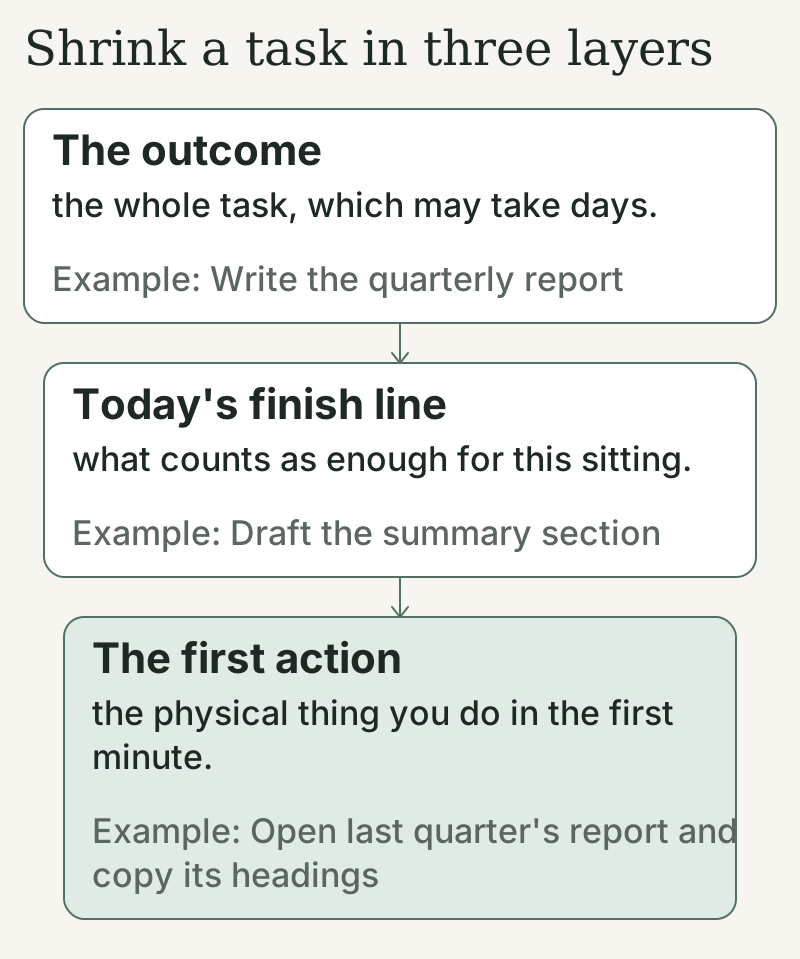
A task on a list often names an outcome, such as "report" or "revision", rather than anything you can do in the next 10 minutes. Shrinking separates three layers:
- The outcome: the whole task, which may take days.
- Today's finish line: what counts as enough for this sitting.
- The first action: the physical thing you do in the first minute.
| Task on the list | Finish line for today | First action |
|---|---|---|
| Write the quarterly report | Draft the summary section | Open last quarter's report and copy its headings |
| Revise for the statistics exam | Complete one past-paper question on regression | Print question 3 and set out a blank page |
| Sort out the car insurance | Get two renewal quotes | Find the current policy number in your email |
| Raise workload with my manager | Book the conversation | Write three bullet points on what I want to change |
A good first action is visible, so you can tell whether you did it. It is specific, so you do not have to decide anything again before starting. It is small enough to begin despite some resistance. And it is real: it changes the state of the actual task. "Touch the file" fails the last test; it lets you feel busy without moving anything.
Permission for a rough first version
For generative work, such as writing, planning, designing or sketching an argument, a deliberately rough first version is often the fastest way past the fear of doing it badly. Tell yourself the first draft is for you, not for anyone else.
Some work needs precision from the start: tax figures, medication, a contract, anything that affects someone's safety. There, shrink by scope rather than quality. Do one section properly rather than all of it roughly.
Preparing to prepare
Preparation helps when it directly opens the task. Gathering the two reference files you need is preparation. Reorganising the whole folder or buying a new notebook is often a pleasant way to put off the first action. If planning itself has become the problem, see how to stop over-planning.
There are two different two-minute rules
Two well-known rules share a name and are often blurred together.
- In Getting Things Done, David Allen's two-minute rule applies when you are processing new items: if an action takes less than two minutes, do it then rather than recording it for later (Allen, 2001). It is a rule for handling incoming work efficiently.
- In Atomic Habits, James Clear's two-minute rule applies to new habits: scale the habit down to a version that takes less than two minutes, such as reading one page, so that starting is almost effortless (Clear, 2018).
Neither rule says that any task becomes easy once you do two minutes of it. For an avoided task, borrow the spirit of Clear's version: make the entry tiny, but make sure it is a real step of the real task.
Start it: decide when and where you will begin
"Later" is not a time. A start that depends on feeling ready tends to wait for a feeling that may not come. A start tied to a specific moment hands the decision to the situation instead.
Write an if-then plan
Psychologists call this an implementation intention: a plan in the form "If situation X arises, then I will do Y". A meta-analysis of 94 independent tests found that forming such plans had a medium-to-large effect on reaching goals across many settings (Gollwitzer and Sheeran, 2006). The effect was measured on goal attainment in general rather than on procrastination specifically, but starting on time is exactly the kind of goal it helps with.
If it is 9:30am and I have sat down at my desk, then I will open the proposal and read the first section.
A good plan has three parts:
- A recognisable cue. Something that will clearly happen: after the 10am meeting, when I sit down on the train, after I make the first coffee.
- The first action from your Stuck Task Card. Not "work on the proposal", but the verb and object.
- A backup. "If the meeting overruns, then I will start at 11:30am instead." Real days move, and a plan with no backup tends to collapse into "tomorrow".
Before you commit, check that the moment is realistic. Will you have the materials, the time and enough energy then? If meetings fill the afternoon, choose a start time when you will actually be available.
Remove one interruption
You do not need to redesign your workspace. Remove the single interruption most likely to derail this start: the phone, the email tab, the chat notification. One change you actually make beats five you mean to make.
Use one well-placed reminder
A reminder helps when it arrives at the moment you planned and names the first action rather than the whole task. "Open the proposal and read section 1" works better than "PROPOSAL!!". If you keep dismissing the same reminder, that is information about the task or the timing, and the article on using reminders when you procrastinate explains how to read it.
Pair it with something you enjoy, carefully
In a field experiment, giving people gym-only access to tempting audiobooks initially increased gym attendance compared with a control group given a bookshop gift certificate, though the benefit declined over time (Milkman, Minson and Volpp, 2014). The researchers called this temptation bundling. To try the idea, save a favourite podcast for a routine task such as filing receipts, and choose a pairing that does not compete for the attention the task needs. The study did not test whether entertainment helps with demanding mental work.
Give the start a boundary
Knowing when you may stop makes it easier to begin. Choose a length, such as 25 minutes, and a natural checkpoint, then decide at the checkpoint whether to continue. If you would like a printable way to prepare a session, the free workbook Your First Focus Session walks through one.
If you already use Dayprints, a Session is one way to do this: choose the task, pick a length, and pause or end whenever you need. Finishing a Session does not mark the task complete; that stays your decision.
Close it: what to do with unfinished tasks at the end of the day

Most days end with something unfinished. That is normal, and it is not a failure. The trouble starts when unfinished work becomes harder to carry because its next step remains undecided. It follows you into the evening and reappears tomorrow with a little extra weight.
There is evidence that a plan helps. In a series of laboratory experiments, Masicampo and Baumeister (2011) found that unfinished goals could intrude on thoughts and interfere with unrelated tasks. Making specific plans for those goals reduced the measured effects without requiring participants to complete the goals first. These were laboratory studies, and they do not promise a peaceful evening. They suggest that specifying when and how you will return to unfinished work may help you turn your attention elsewhere.
The close in four steps
The close takes about 10 minutes. Review the work you meant to handle today, not your entire backlog. If you cannot make every decision before stopping, note anything with an immediate consequence and choose a time to review the rest. The close should not become another unfinished project.
1. Record what moved. Start with progress, including partial progress. In nearly 12,000 diary entries from 238 people in seven companies, progress on meaningful work, including small steps, was closely associated with positive feelings and motivation at work (Amabile and Kramer, 2011). Noticing progress is not self-congratulation. It is information about what worked.
2. Give each unfinished task a destination. For each open commitment, choose one:
- Tomorrow, with a first action. Only if tomorrow has room.
- A later date. A real date when something will be different.
- Unblock. The next action is a question or request to someone else.
- Let it go. Archive or drop it, and tell anyone who was relying on it.
3. Change something before you recommit. Writing "tomorrow" again with nothing changed is how a task becomes a permanent resident of your list. Change the scope, the timing, the information you have or the help you have, or let it go. There is more on this in the chapter on repeatedly postponed tasks.
4. Choose tomorrow's first step. One task and one first action, written where you will see it in the morning. It gives you somewhere to begin tomorrow.
Then stop. You can rest with unfinished work. A next-step note may make returning easier, but you do not have to settle every task before stopping.
The End-of-Day Decision Sheet
- What moved today (including partial progress):
- Each unfinished task: Tomorrow / Later date / Unblock / Let go, and its next action:
- What changes before anything goes to tomorrow again:
- Tomorrow's first step:
- I am stopping at:
A worked example
At 5:45pm Priya closes her day. Moved: the client reply was sent after she checked the tone, and the budget forecast is half done. Unfinished: the forecast goes to tomorrow with a first action, "enter the Q3 actuals from finance's sheet". The team survey goes to a later date, the Monday after the reorganisation is announced, because its questions depend on that news. A conference proposal she has carried for three weeks is let go: she tells her manager she will not submit this year. Tomorrow's first step is the forecast. The list is not empty, and she knows what happens to everything on it.
In Dayprints, the optional end-of-day review shows your completed-task count and lets you choose tomorrow's top priority. For the remaining unfinished tasks, choose Tomorrow, Later or Archive; Later keeps a task without a planned day. Saving the review puts your chosen priority first in Up next and Your Top 3 the next morning.
For the complete routine, including when a short reflection is worth adding, read the daily review guide.
How to stop over-planning and start doing
Some procrastination looks like productivity: rewriting the to-do list, trying another app, watching one more video about a method, colour-coding the calendar. It feels responsible, because you are working on the task, sort of. It can also offer temporary relief from an uncomfortable task, which fits the mood-repair account described earlier (Sirois and Pychyl, 2013).
The signs
- You already know the next action, but you keep refining the plan.
- You are gathering advice about a decision you have already made.
- You switch tools, templates or methods when a task becomes hard.
- The planning is taking longer than the work would.
The 10-minute test
Before planning any further, ask: "What decision will another 10 minutes of planning actually settle?" If you can name one, such as which of two approaches to take or what the client actually asked for, plan for those 10 minutes and stop. If you cannot name one, the planning is finished. Take the first action.
A useful stopping rule is to plan until you have enough to take one safe, useful action. Then act, and return to planning when the work shows you something new.
A worked example
Tom has spent two evenings building a reading tracker for his literature review, with tags, a spreadsheet and a colour key. The next action has been clear since the first evening: read the two most-cited papers and summarise each one's argument in three sentences. What decision would more planning settle? None. He closes the spreadsheet and opens the first paper. The tracker can grow later, if the reading shows he needs it.
When preparation is the work
Some tasks deserve careful preparation: anything high-stakes, unfamiliar or safety-related, such as a legal filing, a medical decision or your first tax return. The difference is whether the preparation reduces a real risk. If it does, it is part of the work. If it only postpones the uncomfortable part, it is avoidance.
If planning is how you feel in control, keep the plan small rather than giving it up. A realistic list of a few priorities is enough structure for most days, and the guide to Today lists and daily capacity shows how to choose them.
What to do when you keep putting off the same task
There are two kinds of recurring task, and they need different treatment. A recurring duty comes back by design: weekly expenses, monthly invoicing, the annual boiler service. A stuck task is a single job that you copy forward day after day. When a task keeps returning unchanged, look at what happened the last time you had a chance to do it.
Audit the last real chance
Think back to the last time you had the time to do it. What happened instead? What were you feeling just before you switched to something else? Was anything missing, such as information, energy or a decision from someone else? The answer may reveal an obstacle or constraint you had not noticed.
Require a changed condition
Before you put the task back on tomorrow's list, change at least one of these:
- Scope: a smaller finish line, or a different first action.
- Information: get the missing fact before trying again.
- Support: ask someone to help, check or sit with you.
- Timing: a moment with more energy or fewer interruptions.
- Ownership: decide whether this is still yours to do.
"Tomorrow, but this time I'll really do it" is the same plan with more pressure attached.
Three different cases
The dreaded phone call. Disputing a bill has been on the list for a fortnight. The obstacle is the moment of confrontation, not the call's length. Changed conditions: write the two points you need to make and the outcome you will accept, find the line's opening time, and schedule the call for then with the notes in front of you. If phone calls are hard for you, ask someone to sit nearby.
Routine admin. Expense claims pile up every month because each one is small and dull. The fix is timing and bundling: attach the task to a fixed cue, such as the first Friday after payday with a coffee, and photograph receipts as they arrive so the monthly job is only the submission.
The project you no longer want. Learning Spanish or restarting a side project has sat on the list since January. The changed condition here is ownership. Decide honestly whether it is still yours. You can drop it, park it with a review date, or shrink it to a version you actually want, such as 10 minutes of an app twice a week. Letting go of a commitment you made to yourself is allowed.
When someone else is relying on it
Renegotiate early and specifically: "I can't finish the full analysis by Friday. I can send the summary figures by Friday, or the full analysis by the 20th." People can usually adjust to a clear change. They struggle much more with silence followed by a missed deadline.
For a step-by-step change-or-release checklist, see stop carrying the same tasks into tomorrow.
How to restart after losing time to procrastination

You meant to start at 2pm. It is now 4pm, and the time has gone to your phone, your inbox and the kitchen. What you do in the next 10 minutes matters more than the two hours that have already gone.
The 10-minute restart
- Acknowledge it in one sentence. "I lost two hours avoiding the forecast." No essay, no verdict on your character.
- Check the real consequences. What is actually at risk now? A deadline, someone waiting, or nothing urgent?
- Repair if you need to. If a deadline is now threatened, tell the person now, while there are still options.
- Choose one remaining priority. The single most useful thing for the rest of today, not the whole original plan.
- Remove one distraction. The one that took the last two hours.
- Run your first five minutes. Go back to the five-minute start with the priority you chose.
Do not try to win the hours back
The instinct after lost time is to cram it into the evening. Resist it. An overloaded evening leaves you tired and makes tomorrow's work feel heavier. Make the rest of today smaller instead. If the whole day has gone rather than a couple of hours, the article on what to do when you feel too overwhelmed to begin shows how to rescue what is left of it.
Why being kind to yourself is practical
It is tempting to think that being hard on yourself will stop it happening again. Research on self-forgiveness and self-compassion offers a reason to question that assumption. In a study of 119 first-year university students, those who forgave themselves more for procrastinating before a first exam procrastinated less when preparing for the next one, and reduced negative emotion appeared to explain the link (Wohl, Pychyl and Bennett, 2010). Across four samples, people who procrastinated more reported less self-compassion and more stress, and self-compassion helped to account for the connection between the two (Sirois, 2014).
These studies found associations; they did not test whether a kinder restart prevents procrastination. Their findings are consistent with taking a less punitive approach. Acknowledge the lost time, then give your attention to the next step.
The 10-Minute Restart Card
- What happened (one sentence):
- What is actually at risk now:
- Any repair needed (who to tell, and what):
- The one priority for the rest of today:
- The distraction I am removing:
- First action:
Restarting more than once
Restarts do not have to be perfect to count. Priya restarts at 4pm, works for 20 minutes, then gets pulled into a chat thread for half an hour. The method has not failed. She runs the restart again, faster this time. You can use the same steps again whenever you need them.
New weeks help, but you do not need to wait for Monday
People are more likely to take on goals just after a "temporal landmark", such as the start of a week, a month or a birthday (Dai, Milkman and Riis, 2014). A new week is a natural moment to reset a plan. For this exercise, though, choose a restart time today rather than waiting for Monday.
When to seek help for procrastination
Practical steps can be worth trying, but persistent or distressing procrastination may need more support. It is worth talking to a professional, such as your doctor, a psychologist or a counsellor, when:
- the delay is persistent and pervasive, across work, home, health and relationships, not just one kind of task;
- it is causing real harm, such as missed payments, a job at risk or medical appointments you keep avoiding;
- it comes with low mood, anxiety, hopelessness, or difficulty concentrating in most areas of life; or
- you have tried practical strategies for several weeks and nothing has shifted.
Procrastination on its own does not mean you have ADHD, depression or anxiety. Research does link them. In a study of 490 adults, people with more ADHD symptoms reported more procrastination, and procrastination was associated with more symptoms of depression and anxiety (Oguchi and colleagues, 2021). That was a single snapshot in time, so it cannot say which comes first.
Structured treatment has shown benefits. In a randomised controlled trial, 150 adults with problematic procrastination took part in an internet-based cognitive behavioural therapy programme, with or without guidance from a therapist, or joined a waiting list. Both therapy groups showed greater reductions in self-reported procrastination than the waiting-list group (Rozental and colleagues, 2015).
This guide, its worksheets and any productivity app are not treatment. If you recognise yourself in the list above, asking for help is a sensible next step, not an overreaction. If you are in crisis or thinking about harming yourself, contact your local emergency number or a crisis line now.
A seven-day plan to practise starting and returning
You do not need a programme to use this guide. If you would like a structure, practise one part of the loop each day for a week and notice which part helps you most.
| Day | Practice | Time |
|---|---|---|
| 1 | Run the five-minute start on one task you are avoiding. | 5 minutes |
| 2 | Fill in a Stuck Task Card for the same task or another one. | 5 minutes |
| 3 | Write one if-then plan, and notice whether the cue happened. | 2 minutes, plus the start |
| 4 | Catch one moment of over-planning and ask what decision it would settle. | 1 minute |
| 5 | Audit one task you keep postponing, and change one condition. | 10 minutes |
| 6 | Close the day by giving each unfinished task a destination. | 10 minutes |
| 7 | Look back at the week. Which practice helped most? Keep that one. | 10 minutes |
Missed a day? Carry on from where you are; there is nothing to restart. The seven-day plan does not promise a lasting habit or an end to procrastination. Its purpose is to help you find the practice that makes the most difference for you.
If you would like a printable week focused on planning rather than procrastination, the free 7-Day Reset workbook has seven short exercises.
Try Dayprints: Keep a short Today list, time one task with a Session, and use the optional end-of-day review to decide what happens to unfinished work. Finish at least one planned task and decide everything else on today's list and in Needs attention, and the day is kept as a Dayprint: a framed, dated painting in your collection. Dayprints works in your browser, and you can start on Free without a payment card.
Frequently asked questions about procrastination
What causes procrastination?
Usually a task that feels unpleasant, uncertain or far from any reward, while something more pleasant is within reach. Researchers describe procrastination as short-term mood repair: delay makes a bad feeling go away now at a cost later. Sometimes the real cause is practical, such as a blocked or unrealistic task. See what procrastination is and why we do it.
Is procrastination the same as being lazy?
No. Putting off one task does not tell you how willing someone is to work; many people who procrastinate are working hard on other things. Procrastination is choosing to delay something you intend to do despite expecting to be worse off. Calling yourself lazy does not identify the obstacle, and it can make the feeling you are avoiding worse.
How do I stop procrastinating and start studying?
Choose one concrete study action, such as attempting one past-paper question or summarising one lecture in five sentences. Prepare only what that action needs, put your phone out of reach, and work for a short, fixed period. Then decide whether to continue. You can adapt the five-minute start to one study action.
What is the two-minute rule?
There are two. David Allen's rule, from Getting Things Done, applies while processing incoming items: if an action takes under two minutes, do it then rather than recording it for later. James Clear's rule, from Atomic Habits, says to scale a new habit down to a version that takes under two minutes. Neither means that any task becomes easy after two minutes. Read the distinction between the two-minute rules.
Is procrastination a sign of ADHD?
It can accompany ADHD, and research finds that adults with more ADHD symptoms report more procrastination. But procrastination alone cannot establish ADHD; almost everyone procrastinates sometimes. If it is persistent, affects most areas of your life and comes with other difficulties, talk to a professional. See when to seek help.
Why do I procrastinate on things I actually want to do?
Wanting the result is not the same as feeling comfortable with the steps. A project you care about can carry the fear of doing it badly, or an unclear first step, and caring more can raise the stakes. Name the moment you are avoiding, then choose a small first action. If the task allows a rough draft, give yourself permission to make one.
How long does it take to stop procrastinating?
There is no fixed timeline. Try one practice on a few occasions and notice whether it helps you begin or return to a task. The seven-day plan is a way to explore the tools, not a deadline for improvement. Persistent or distressing procrastination may need structured support.
Sources and research notes
The studies below are cited in the text. They include reviews, which summarise earlier research; observational studies, which show associations rather than causes; and experiments or trials, which test an intervention. The four-step loop, the timings and the worksheets in this guide are practical tools based on this research. They have not themselves been tested as an intervention.
- Allen, D. (2001). Getting Things Done: The Art of Stress-Free Productivity. Viking.
- Amabile, T. M., and Kramer, S. J. (2011). The power of small wins. Harvard Business Review, 89(5), 70–80.
- Blunt, A. K., and Pychyl, T. A. (2000). Task aversiveness and procrastination: A multi-dimensional approach to task aversiveness across stages of personal projects. Personality and Individual Differences, 28(1), 153–167. doi:10.1016/S0191-8869(99)00091-4
- Clear, J. (2018). Atomic Habits. Avery.
- Dai, H., Milkman, K. L., and Riis, J. (2014). The fresh start effect: Temporal landmarks motivate aspirational behavior. Management Science, 60(10), 2563–2582. doi:10.1287/mnsc.2014.1901
- Gollwitzer, P. M., and Sheeran, P. (2006). Implementation intentions and goal achievement: A meta-analysis of effects and processes. Advances in Experimental Social Psychology, 38, 69–119. doi:10.1016/S0065-2601(06)38002-1
- Johansson, F., Rozental, A., Edlund, K., Côté, P., Sundberg, T., Onell, C., Rudman, A., and Skillgate, E. (2023). Associations between procrastination and subsequent health outcomes among university students in Sweden. JAMA Network Open, 6(1), e2249346. doi:10.1001/jamanetworkopen.2022.49346
- Masicampo, E. J., and Baumeister, R. F. (2011). Consider it done! Plan making can eliminate the cognitive effects of unfulfilled goals. Journal of Personality and Social Psychology, 101(4), 667–683. doi:10.1037/a0024192
- Milkman, K. L., Minson, J. A., and Volpp, K. G. M. (2014). Holding the Hunger Games hostage at the gym: An evaluation of temptation bundling. Management Science, 60(2), 283–299. doi:10.1287/mnsc.2013.1784
- Oguchi, M., Takahashi, T., Nitta, Y., and Kumano, H. (2021). The moderating effect of attention-deficit hyperactivity disorder symptoms on the relationship between procrastination and internalizing symptoms in the general adult population. Frontiers in Psychology, 12, 708579. doi:10.3389/fpsyg.2021.708579
- Rozental, A., Forsell, E., Svensson, A., Andersson, G., and Carlbring, P. (2015). Internet-based cognitive-behavior therapy for procrastination: A randomized controlled trial. Journal of Consulting and Clinical Psychology, 83(4), 808–824. doi:10.1037/ccp0000023
- Sirois, F. M. (2014). Procrastination and stress: Exploring the role of self-compassion. Self and Identity, 13(2), 128–145. doi:10.1080/15298868.2013.763404
- Sirois, F., and Pychyl, T. (2013). Procrastination and the priority of short-term mood regulation: Consequences for future self. Social and Personality Psychology Compass, 7(2), 115–127. doi:10.1111/spc3.12011
- Steel, P. (2007). The nature of procrastination: A meta-analytic and theoretical review of quintessential self-regulatory failure. Psychological Bulletin, 133(1), 65–94. doi:10.1037/0033-2909.133.1.65
- Steel, P., and König, C. J. (2006). Integrating theories of motivation. Academy of Management Review, 31(4), 889–913. doi:10.5465/amr.2006.22527462
- Tice, D. M., and Baumeister, R. F. (1997). Longitudinal study of procrastination, performance, stress, and health: The costs and benefits of dawdling. Psychological Science, 8(6), 454–458. doi:10.1111/j.1467-9280.1997.tb00460.x
- Wohl, M. J. A., Pychyl, T. A., and Bennett, S. H. (2010). I forgive myself, now I can study: How self-forgiveness for procrastinating can reduce future procrastination. Personality and Individual Differences, 48(7), 803–808. doi:10.1016/j.paid.2010.01.029
A note on a study this guide does not use. A widely cited 2002 study on self-imposed deadlines by Ariely and Wertenbroch was retracted by Psychological Science in September 2026 after its data were found to be unreliable (retraction notice).